
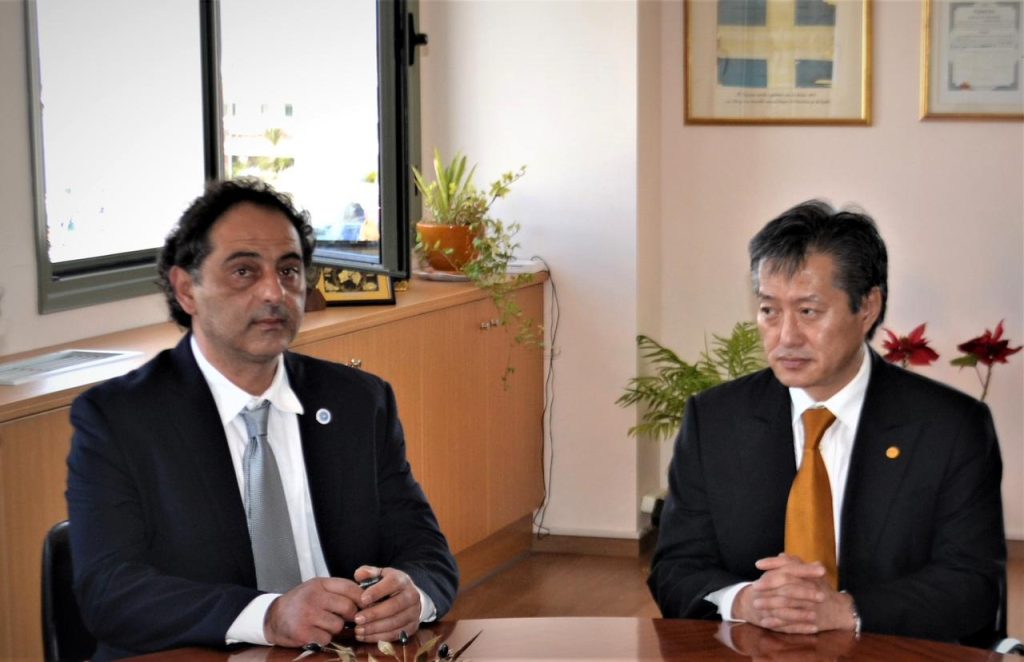
The VIII Dan Greek shares his experience from the early days to the current challenges and future aspirations of ITF Taekwon-Do in Greece.
How did you start practicing ITF Taekwon-Do and what were your initial motivations for getting involved in this discipline?
I started studying Taekwon-Do in the 80s in the city of Preveza at the age of 10. My first teacher was Friksos Chatzinikolaou. I always had a passion for sports, mainly athletics and swimming, until a friend convinced me to join a Taekwon-Do class. I was immediately fascinated and enrolled in the school, although I found it difficult to adapt as I was a rather restless child who found it hard to follow rules. However, after receiving my green belt, I became a more active student and started training more and attending events and competitions regularly. I began to understand the true meaning of Taekwon-Do and it became a way of life for me, as its founder, General Choi, stated. In 1986, our teacher announced that he would have to leave our city after a year, and suggested to me and my classmate Mina Tzavala to lead the school in his absence. So, in 1987, I started my journey as a teacher. After that, a crucial role for me, both as a student and as a teacher, was played by the pioneer and great man Giorgos Stilianidis, with whom I taught and was inspired towards the right path. Finally, regarding the question about my initial motivation, what has given me strength all these years is the need for everyone, especially the new generation, to understand the incredible art created by General Choi.

Can you share some details about the early practitioners? What were the most memorable or exciting moments of their careers so far?
Taekwon-do in Greece began in the capital city of Athens in 1968 with Mr. Stamatis Kassis, who learned in Germany. In Thessaloniki, in 1967, it began with Giorgos Stilianidis, Stefanos Kaizatzakis, and Mr. Chrysogelos. The 4 schools were the beginning of the spread of Taekwon-Do throughout Greece. What played an important role for those instructors was the support they received from Korean instructor Joong-Keun Kim, as well as the regular presence of General Choi in Greece through international seminars held at that time. The evolution was then based on the work of the black belts that emerged from these four schools. Since the 80s, Taekwon-Do was highly evolved in Athens and Thessaloniki, and was beginning to be taught in the rest of Greece. By 2002, Stilianidis Georgios played the most important role in the organization, recognition, and dissemination, managing to promote Greek Taekwon-Do not only in Greece but also internationally. It was the greatest honor to host the fifth world championship in Athens in 1987 at the Peace and Friendship Stadium. It was an event that amazed everyone and, as General Choi said, it was one of the best that had been held up to that point.
What were the most significant challenges faced by ITF Taekwon-Do during its early years in Greece, and how were they overcome?
The biggest challenge in Greece was the constant struggle against the Greek government to be recognized as a separate system and not the same as the World Taekwondo Federation. In 1987, the Greek government finally recognized the ethnic organization of Taekwon-Do. For many years, the ITF coexisted with the WT and the challenges were too many to count, as most of the organization belonged to the WT, which caused problems for Greek ITF. That was until 1999, when after a great effort by Stilianidis, the ITF was finally recognized as a separate organization.
Over time, how has the popularity of ITF Taekwon-Do in Greece evolved? Were there key moments that drove its growth?
During the early years of Taekwon-Do, the term “Korean Karate” was used, meaning that they were using a familiar term to make it more known in Greece. Later on, the effort to make it known with its own true terms became greater and thus its meaning, art, and philosophy conquered many students. Not long after, in the 80s, it became one of the most popular martial arts in Greece. In my opinion, the factor that played the most important role in making Taekwon-Do the third most popular sport today in Greece was the World Championship in 1987 in Athens, the distinctions of the international teams, as well as the distinctions of three Olympic Taekwon-Do athletes, Michali Mouroutsou, Aleksandros Nikolaidis, and Elli Moustakidou. I consider those aspects to have been the key components behind the reasons why both the younger and older generation are dedicated to ITF Taekwon-Do.
Let’s talk about infrastructure and organization in Greece. How were the first schools and associations established, and how has the network grown over time?
As I mentioned before, the first schools that started teaching were in Athens and Thessaloniki, the two largest cities in Greece. Their first black belts helped spread this art throughout the rest of Greece. This widespread dissemination created the need for better organization, so the first Greek organization was created, which the Greek government recognized. This recognition changed everything, as Greek Taekwon-Do had the support of the Greek state for better organization of international championships. It also became possible to create and send stronger teams to international competitions. In 1999, the Greek government provided the opportunity for the existence of two national organizations representing the two different systems of Taekwondo, ITF, and WT.
In terms of instructor and black belt training, how has the ITF Taekwondo education system evolved in Greece since its inception?
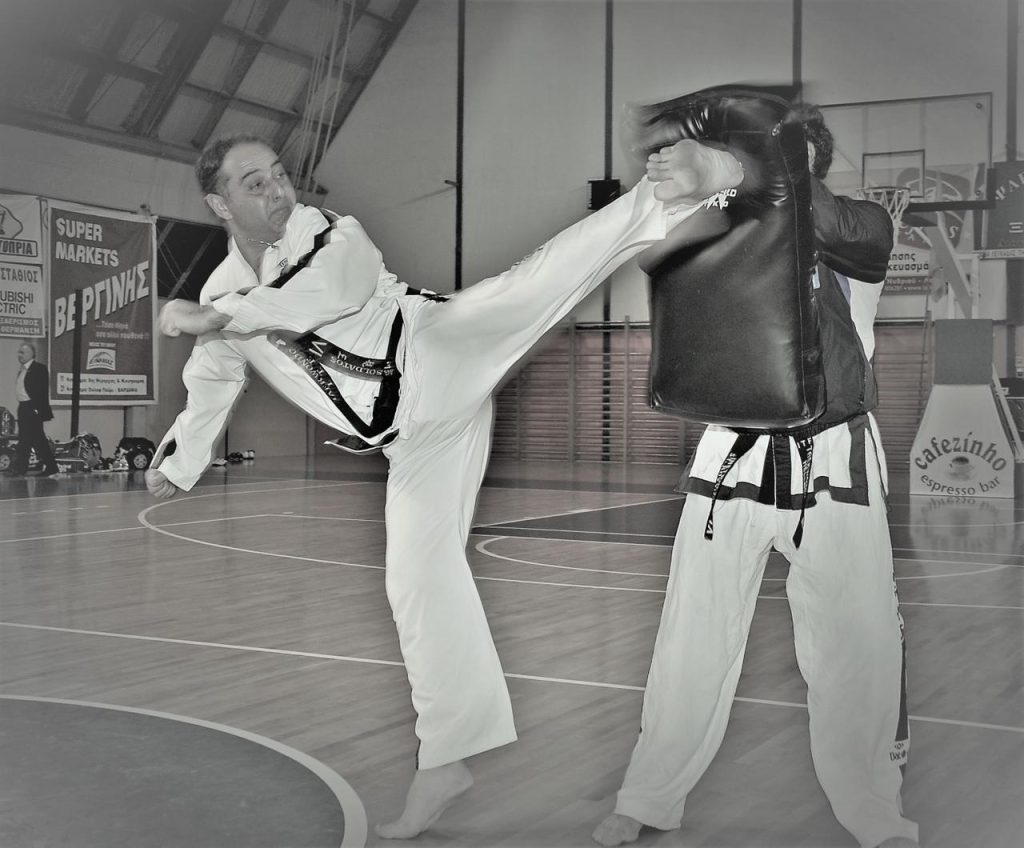
The improvement of black belts and school owners is from the beginning due to national and international seminars held not only in Greece but also abroad. A large number of instructors and black belts were taught by General Choi while he was still alive and by other great Grand Masters and Masters. We, as a national organization, have placed great importance in recent years on national seminars that aim to individualize the way Taekwon-Do is taught, the improvement of all black belts, as well as its philosophy and the ideals it represents. By promoting this, we ensure the future of Greek Taekwon-Do so that it can continue to be great and thrive.
What is your perspective on the contribution of ITF Taekwon-Do in Greece to the development of martial arts in the country?
The spread of Taekwon-Do in Greece was rapid because it changed Greeks’ mentality towards martial arts. In the past, Greeks believed that martial arts were for violent people who learned a martial art to use it against others. However, the path and art of Taekwondo changed this opinion and proved that the practice of martial arts does not promote violence. Through proper training in martial arts, important characteristics and talents are developed that are essential for a person to face the difficulties and challenges of life.
In terms of competition, how has the participation of Greek athletes in international tournaments developed over time?
The participation of Greek athletes in international championships is high. Many athletes have received awards at both European and world levels. Some of the greatest distinctions of Greek athletes were during the world championship in Korea in 2010 and the world championship in England in 2016. Of course, we continue with our hard work and effort, always aiming towards a brighter future.
What is the preparation of competitors like before a major tournament?
The preparation of our athletes is done in an unusual way. The athletes that make up the team follow a special program instructed by the team’s coach, which is based on their increase in efficiency over a long period of time. These programs always aim to improve their physical condition, strength, endurance, speed, but also and most importantly, their efficiency and combat tactics. Usually, a month before a tournament, all athletes participate in a training camp with more intensive and goal-oriented training.
Looking ahead, what are the goals and aspirations for ITF Taekwon-Do in Greece? Do you see opportunities for further growth and recognition at a national and international level?
Our goals and ambitions for the future of Greek Taekwon-Do are the organization of larger events such as international seminars and international championships. My great dream is to host a European or World Championship in Greece. Within this year, we have set many goals such as organizing the annual summer camp in June. Our goal is to attract more teams from other countries to train with them for the upcoming competitions. We have also set a high goal to present a successful appearance at the European championships in Wales. But also the organization of a major tournament in September with well-known athletes. Last but not least, I would like to say that my dream for us, who consider ourselves ambassadors of General Choi’s vision for a peaceful world, is to leave our personal benefits and ambitions behind and work together for a united and strong Taekwon-Do.